

Disclosure Day
What if we’re not alone?

What if we’re not alone?
It’s the question that expresses the human race’s greatest hopes and deepest fears. The answer, either way, is frightening. Maybe we’re alone in the universe; maybe we’re all we’ve got and no one is coming to save us from ourselves. Maybe we’re not alone, and whoever is out there wants to destroy us. There’s horror in the question, but there’s also hope. Maybe whoever’s out there is benevolent. Whether the someone out there is a higher power or aliens or both, answering the question in the positive sense—we are not alone, and they mean us no harm—takes faith. Steven Spielberg’s Disclosure Day examines the faith of true believers, religious and conspiracy theorists alike, and finds that faith shot through with an energizing, earnest hope.
Spielberg’s particular flavor of alien-oriented science fiction has always carried notes of wonder. He is good at getting his actors to gape, awestruck, and at getting us to gape at the movie screen in response. In that sense, Disclosure Day is similar to its predecessors. It’s thrilling work: a mystery intertwined with a conspiracy wrapped up in a road movie, populated by believably ordinary people muddling their way through.
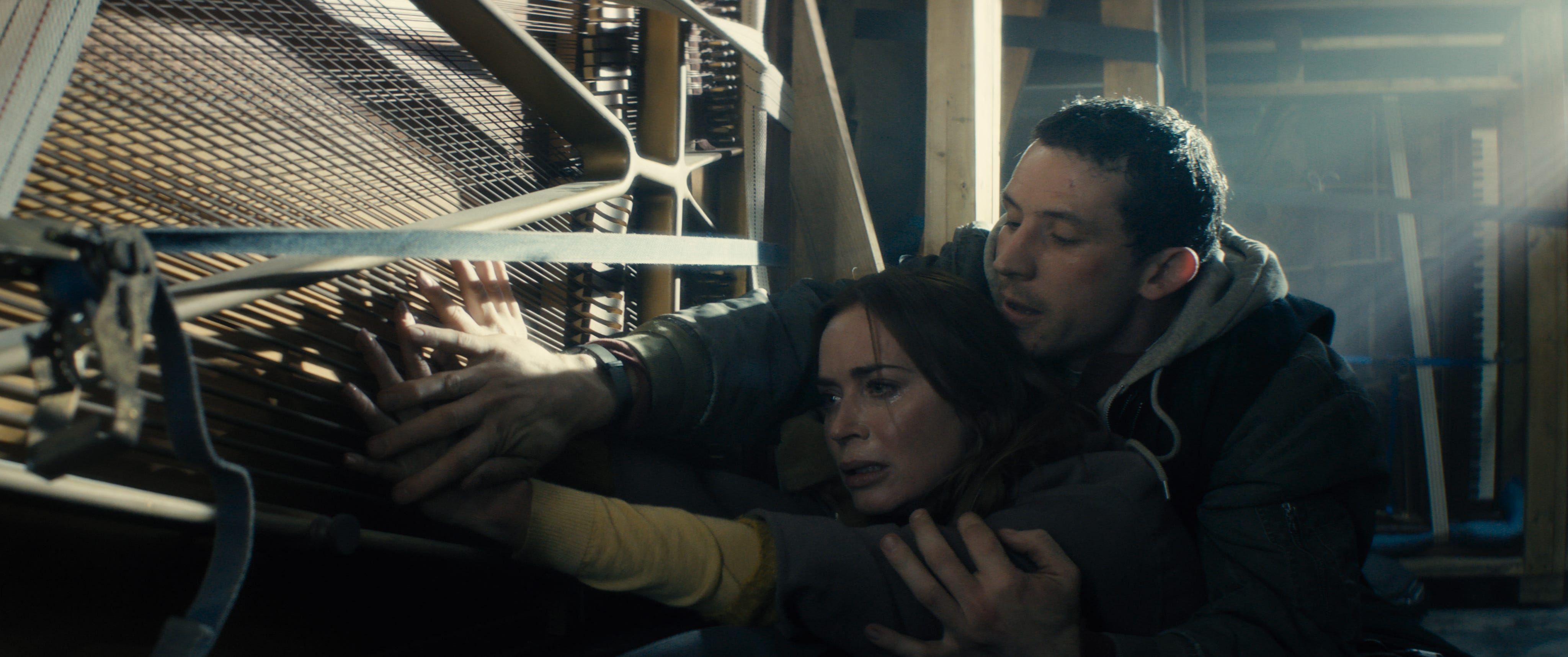
The movie drops us in medias res into a tantalizing scenario, and David Koepp’s script paired with Spielberg’s direction gives us just enough information to feel our way out of the initial disorientation without frustrating us. Daniel (Josh O’Connor) has discovered proof of a conspiracy that promises to shake the world. He believes that it’s his responsibility to bring the truth to light, but he is pursued by a shadowy organization that would rather not see that truth revealed. Meanwhile, halfway across the country, Margaret (Emily Blunt) has a strange encounter with a cardinal that flies through her window. Shortly afterward, she is able to speak and understand other languages—a small-scale Pentecost that startles her and catches the attention of the same organization working to cover up Daniel’s evidence. Margaret knows things she shouldn’t, secret truths that she can’t help but reveal. She’s caught up in something bigger than herself. “I’m just a passenger,” she says, because she can’t control it once it takes hold of her. Sometimes belief isn’t a conscious choice.
Disclosure Day is keenly interested in the truth, and who gets to tell it, and who gets to hear and believe it. The truth is clear and honest; hidden knowledge is treated as a tool for control, while the truth, in this film, is always beneficial in the telling. That doesn’t mean telling it is easy. Daniel’s evidence has the potential to turn an already unstable world upside down; in the background, World War III is breaking out, and society may not be able to withstand another unexpected blow. After a car chase, Margaret has a panic attack that arises as much from her own newfound knowledge as from the stress of being pursued. Daniel brings her down from it with a full-body embrace and instructions to breathe deeply. Faith may live in the heart, but it’s embodied—hands, lungs, and all.
Spielberg is a master of evoking that full-body feeling of awe and adrenaline. Here, he does it with smooth, sweeping camera movements that push in as his characters go on the run, with a variation of the same train crash that has haunted him since his childhood (as re-created in The Fabelmans). Most effectively, he does it with an interrogation scene featuring two characters seated across a table from one another. One of them (Colin Firth) calls the shots and is in control, while the other (Eve Hewson) is frightened and disoriented. The two remain seated the entire time; they never make physical contact, yet a palpable sense of danger lurks as the two characters match wills.
I would have liked to spend more time with Hewson’s character, a former novitiate who says she never lost her faith even though she “lost [her] calling.” The script is content to leave her character as that simple sketch in the margins and to spend its time shading in the moments that conjure outright awe and wonder. That awe is accompanied by certainty: I am seeing this, and it’s real, even if it’s supposed to be impossible. But faith isn’t certainty; it is trust in something that is uncertain from the outside. Disclosure Day depicts the leap from hidden secrets to openly held knowledge, and it understands how frightening that leap must be. Although it feels a touch too assured about its own landing place, I can’t fault it for its faith in its own story and in the audience watching it. Taking such a leap requires hope, which feels thin on the ground these days. I’ll take it where I can get it, and I’m glad to have found it offered by a master storyteller. —Sarah Welch-Larson
★★★☆
Disclosure Day is in theaters everywhere now.