

Superman
A good guy fighting for justice in a callous world.

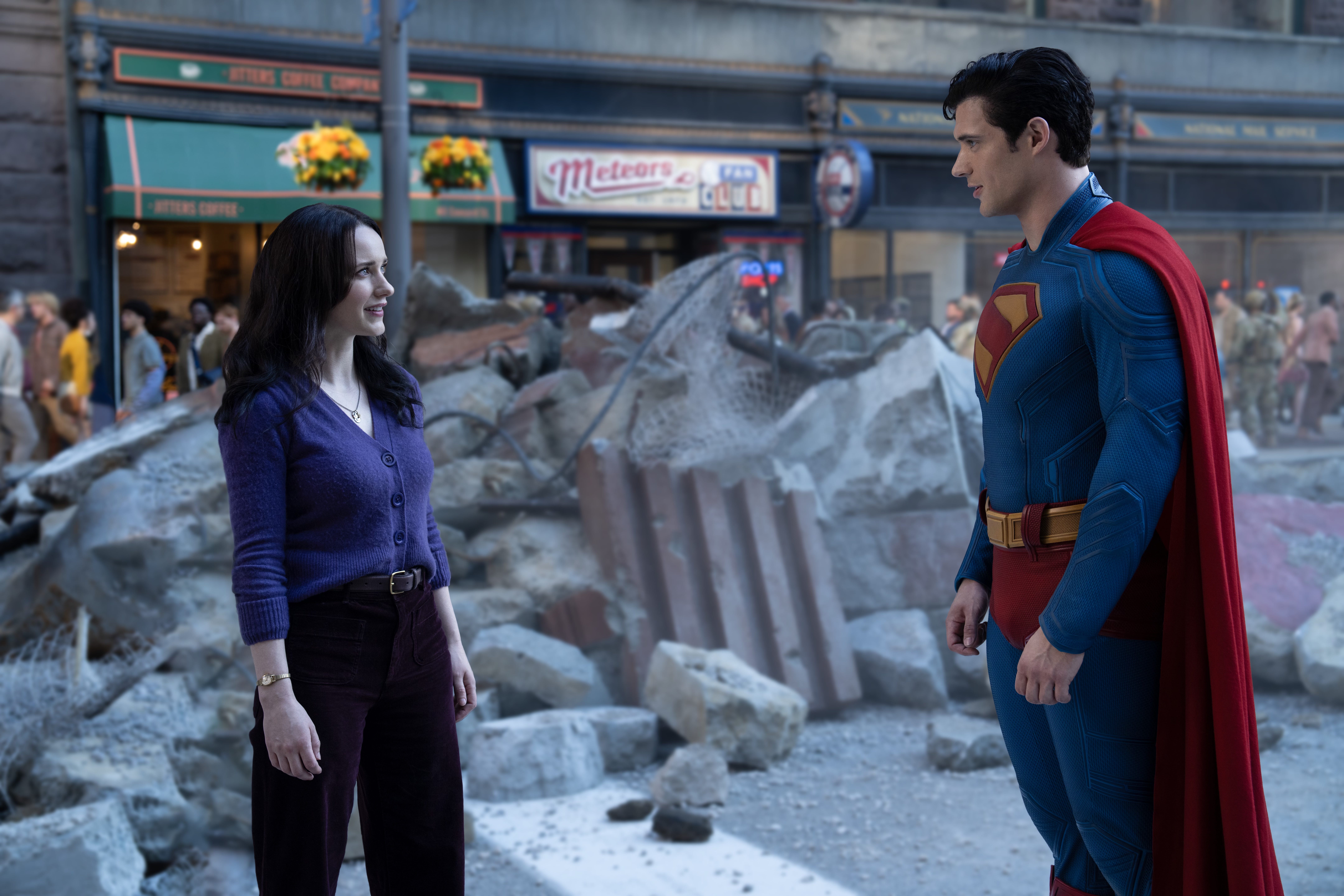
Every reboot is a response to the franchise entries that came before it. In this latest installment of the Superman mythos, writer/director James Gunn throws the seriousness of Zack Snyder’s take on Superman movies out the window. The blue of Superman’s suit is so bright it’s almost teal, and the costume includes the iconic red briefs and a yellow “S” shield on the back of the cape, details that return the character’s design to the look of earlier comics. His Fortress of Solitude is crystalline and otherworldly, a return to the fanciful miniatures from Richard Donner’s 1978 Superman. The camera is often tilted upward, Superman held steady in its sights as he flies and floats: a visual choice that suggests optimism and clarity. The film doesn’t quite manage to live up to its ideals, but it gets close—and it has fun while it’s doing so.
Superman showcases its action in long, swooping takes that hearken back to the opening sequence of Gunn’s own Guardians of the Galaxy Vol. 2. Moments of crisis are portrayed from the point of view of watching civilians. One of the single-take battles swirls around Lois Lane (Rachel Brosnahan) as she gapes at the action; other, smaller moments place the camera near the eye level of unnamed characters being rescued from monsters and falling debris, all while Superman strains to keep danger at bay long enough to give people a chance to escape. We are on Superman’s side but are distanced a little from him. These angles work well when the story concerns itself with Superman’s abilities, though it strains harder when trying to come up with resolutions that don’t involve fighting. We do not get enough of Superman's mild-mannered alter ego, Clark Kent.
David Corenswet plays both sides of the character as a more or less cohesive whole, his transitions between the two identities unmarked—no shifts in posture like Christopher Reeve before him. He sports only a pair of thick glasses and a messy hairstyle to hide his secret identity, as though Clark is a hasty disguise for the hero underneath. The blurred line between Clark and Superman is intentional. This version of the character is more unsure of himself, even as Superman, than previous iterations. The world is complicated, and it’s hard even for a man with a powerful moral compass to try to make right.
He’s going to try anyway, whether he’s rescuing small animals or trying to stop hostile countries from invading their neighbors. When Superman makes a decision that runs counter to the United States’ foreign policy, Lois questions his plans for dealing with the fallout; all Clark can say to defend himself is that he can’t just let people die. Injustice, big or small, is still injustice, and Superman is firmly on the side of the underdog in all cases, even when it’s unpopular. The consequences can come later; he’s just trying to hold it all together in the moment.
And there’s a lot to hold: border crises abroad, a conspiracy at home by tech businessman Lex Luthor (Nicholas Hoult) to usurp his reputation, a burgeoning romantic relationship, an annoying colleague in the form of Green Lantern (Nathan Fillion), his anxieties about living up to his parents’ expectations, and an unruly superpowered dog named Krypto. The story gets messy, with threads disappearing and then picking back up as the script requires them. In the end, justice is still delivered via punching rather than creative uses of Superman’s powers (such as the Man of Steel using his body to fill a gap in a train track in the 1978 film, a goofy solution that eschews violence for creative thinking). This installment aspires to Superman’s nonviolent aims, but when push comes to shove, the villains are still going to get a violent comeuppance. The contradiction doesn’t live up to the character’s ideals, though Gunn affirms that it’s good to fight for decency in the face of greed and injustice.
The pieces that work manage to do so because the movie does understand what motivates its central characters. Superman wants to do right; Lois wants to find the truth; Lex Luthor wants to be the greatest at everything. Hoult’s performance as Luthor is the first movie version of the character that feels believable. He’s intimidating as a guy with a lot of resources and just enough intelligence to do some real harm, fueled by petty resentment of others for their successes. In a moment of petulance, Luthor smashes a mug on the ground just so he can order helpless lackeys to pick up the pieces. By contrast, Superman is interested in other people and their own potential to do good, to make mistakes and get back up again and keep trying to be better. The characterization—like the rest of the movie—might be over the top and imperfect, but it still rings true.—Sarah Welch-Larson
★★★☆
Superman is in theaters everywhere now.
I think it's because the line of identity is so blurry in this one that I didn't feel the lack of Clark Kent moments that you did. Like, do you consider the "kindness is punk rock" scene to be a Superman or Clark scene?