

The Bride!
An unholy alliance of influences.

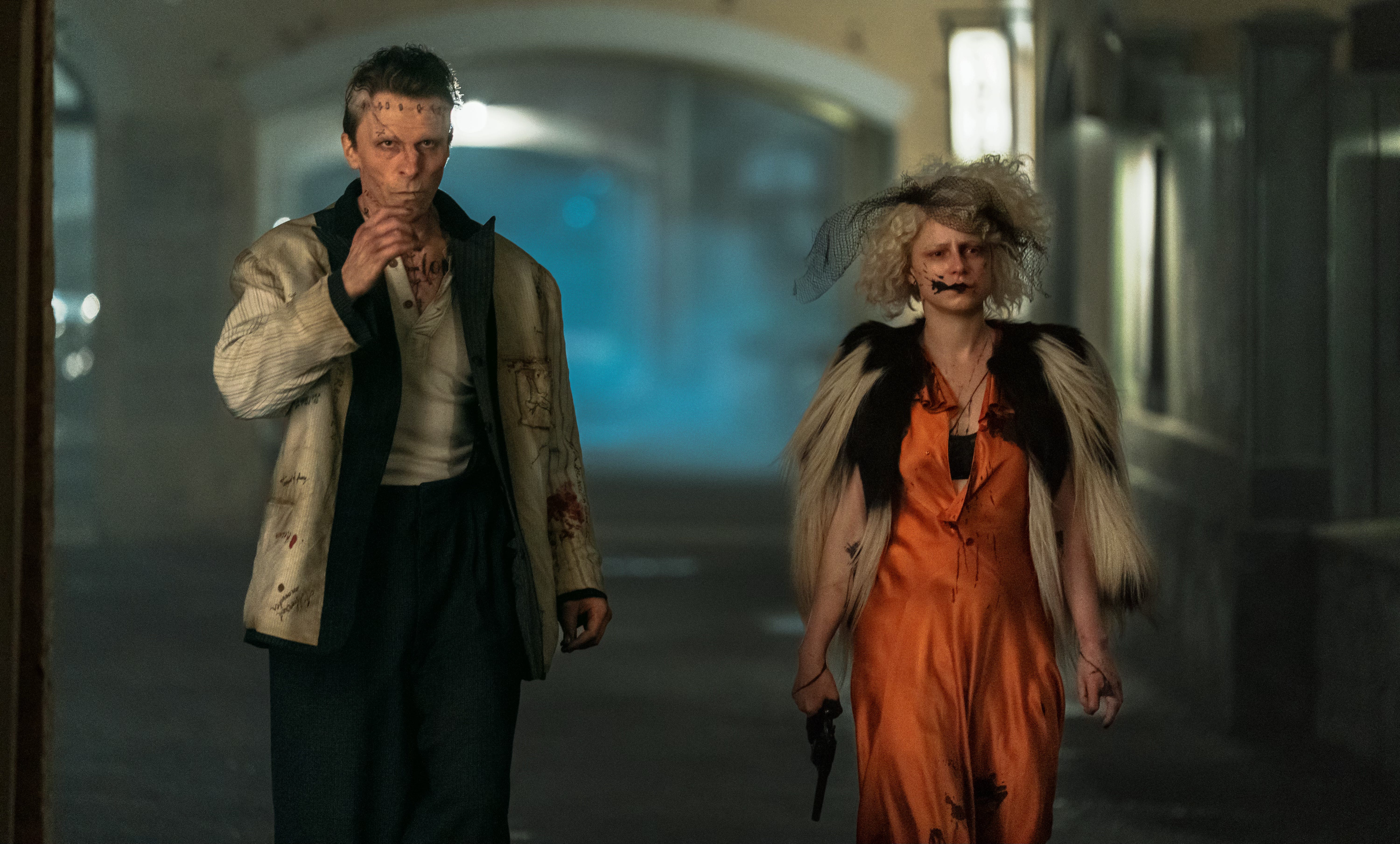
It’s the 1930s in Chicago, and everyone’s a gangster, or at least in the employ of one. The Art Deco glamor has faded to a sense of desperation: the rich glitter, and the poor watch them live the lives they want on silver screens. James Whale’s Frankenstein (1931) came out during this decade, with Bride of Frankenstein following four years later. The former begins with an actor directly addressing the camera, telling the audience that the movie they’re about to see will shock and upset them; the latter opens with a period scene in which Elsa Lanchester’s Mary Shelley begins to tell a horror story, a sequel to her novel. Maggie Gyllenhaal takes the pieces of those previous adaptations—plus dozens of other influences from cinematic history—and throws them all into a blender. The resulting concoction is The Bride!, a rebellious, angry, feminist love story that wants to devour and re-create its own influences into something new. It’s not always successful, but it is always interesting.
The Bride! shows its hand immediately; its prologue is a black-and-white address to the camera by Mary Shelley’s ghost (Jessie Buckley), remixing the prologues to the 1931 and 1935 films. Shelley is long dead and yet still haunted by her own creation. Her face is lit to look like a skull, her voice ghoulish. “What I wanted to write, what I needed to say, I could not write!” she declaims. She’ll come back from the dead to possess a living woman (also played by Buckley), who in turn will also die and be reanimated. The boundaries between life and death are always porous in Frankenstein movies; the monster keeps dying and coming back to life, always returning because of some unfinished business on the storyteller’s part. Gyllenhaal’s retelling is also interested in the porous borders between story and storyteller, in the ways we come to understand ourselves through the stories we tell and the movies we watch.
Up until now, the character of the Bride of Frankenstein has usually been an afterthought. She is present in the original novel, though she is destroyed before she can even be brought to life; she lives for only five minutes at the very end of the 1935 movie that’s named for her. In that film, she’s feral; Elsa Lanchester plays her like a wild animal, hissing and screaming her horror at being created to be the mate of a monster. Buckley’s portrayal is just as animated and much more verbal, flipping between personalities as the formerly dead woman and Shelley fight for control over her body. She is hungry, and she doesn’t care who knows it. This is her story, and she’ll fight tooth and nail to be at its center.
The Bride doesn’t have scars the way most Frankenstein movie monsters do. She isn’t sewn together. Instead, she has marks on her skin that look like blotches and lines of ink. She is a work in progress, messy and imperfect: a person as a draft instead of a polished piece. The mad scientist who reanimates her (Annette Bening) refers to the Bride’s existence as a kind of “disobedient geometry.” To the scientist, the Bride is a walking contradiction who has been given life to be a companion for the lonely, legendary monster, who has taken his creator’s name and now goes by “Frank” (Christian Bale).
Frank has lived a lonely life, desperate for company. Unlike Buckley’s character, he is actually stitched together from corpses, oozing and wretched; Bale plays him with a tenderness that belies the monster’s capacity for brutal violence. He escapes to the movies whenever he needs to drown out the rest of the world. He literally sees himself on screen, living out the joys he longs for alongside the movie star (Jake Gyllenhaal) whose work he loves.
The line between film and real life also is porous. Maggie Gyllenhaal’s script and direction keep folding in visual nods to other movies, from Young Frankenstein’s “Putting on the Ritz” sequence to a His Girl Friday detective duo to the drab, glamorous desperation of Bonnie & Clyde (1967). Nearly all of these movies turn on characters who act on a dare. The Bride! claims that the novel on which it’s loosely based was also written on a dare. At the same time, the titular figure continually has to assert that she “would prefer not to” do whatever she’s asked to do, a rejection of social obligation that sometimes reads as a feminist statement and other times reads simply as apathy. The repeated line loses its power with each invocation: it’s rebellion as a preference, instead of the life-or-death argument that the script seems to think it’s asserting.
The movie prefers to be punk rock; it has the aesthetic, but not the sensibility. All the many nods to other films about escapes and dares feel empty. They are reanimated shadows of the real things they invoke. Prisoners don’t just prefer escape; they need it to survive. A half-escape, parting the veil only slightly, is no real way to live. —Sarah Welch-Larson
★★☆☆
The Bride is in theaters everywhere now.
Sarah wrote a book about the Alien movies! You can pre-order the second edition of Becoming Alien: The Beginning and End of Evil in Science Fiction’s Most Idiosyncratic Film Franchise from the publisher now.