

The Drama
Marriage on the rocks before it even begins.

The Drama opens with a shot of Zendaya’s ear, the camera positioned at a 90-degree angle to her head. The score and sound effects are muted. It’s a prelude to a disastrous meet-cute in a coffee shop between Charlie (Robert Pattinson) and Emma (Zendaya), in which he tries to hit on her without success—she’s deaf in the ear we’ve just seen. She can’t hear his advances; he assumes she’s ignoring him. (The sound design clues us in to the situation before either character figures out what is going on.) When she finally realizes what he is trying to do, she offers him a chance to try again. This time, the introduction sticks, and the two go on to get engaged.
The shot of Zendaya’s ear still looms over the rest of the film, set in the days leading up to the protagonists’ wedding. The image echoes Blue Velvet, in which David Lynch lovingly takes a tour around a sleepy small town before diving into the dirt, which is swarming with bugs just below the surface. In the Lynch film, Kyle MacLachlan finds a severed human ear in a field, discovering along with it the rot at the heart of his seemingly perfect hometown. In The Drama, the rot is hidden in the hearts of its protagonists. When it comes to light, Charlie and Emma must decide whether the love they profess for each other is strong enough to overcome each other’s worst impulses.
It starts innocently enough: maid of honor Rachel (Alana Haim—very good here) suggests a game in which she, best man Mike (Mamoudou Athie), Charlie, and Emma each confess the worst thing they’ve ever done to each other. It’s a getting-to-know-you game with stakes, an excuse to laugh at their own worst selves and admit to behavior they’re not proud of with friends they trust. At least until Emma’s turn: the worst thing she ever did wasn’t something she actually did, but the mere act of planning it is still shocking. It’s the kind of act that can’t be undone, that no human can truly atone for. Rachel is aghast; Charlie is disbelieving, and Mike just wants to smooth things over. Suddenly the wedding is a fraught proposal. Charlie’s eagerness to get married feels like recklessness; what if his wife-to-be is still capable of planning—and then carrying out—something horrible? Writer/director Kristoffer Borgli leans into the discomfort. His movie isn’t really about a disastrous wedding; it’s about the projections of our loved ones we carry around in our heads. It’s about the question of whether, if we were to know our loved ones’ darkest secrets, we could still love them.
Borgli communicates that doubt through subjective cross-cutting from conversations between two characters to a third person, usually the subject of the conversation who isn’t actually in the room with them. Before Emma bares her worst self, Charlie talks about her with Mike, describing her best traits, which we see in montage. For her part, Emma thinks of Charlie fondly as “just a weird little British freak,” a characterization that leans into Pattinson’s real-world persona as an unpredictable agent of chaos. We see a flashback of the two on an early date, sneaking after-hours into the museum where he works as a curator. When the security system goes off, the two share their first kiss: a sign of their affection for each other, and perhaps also a red flag for the pain to come.
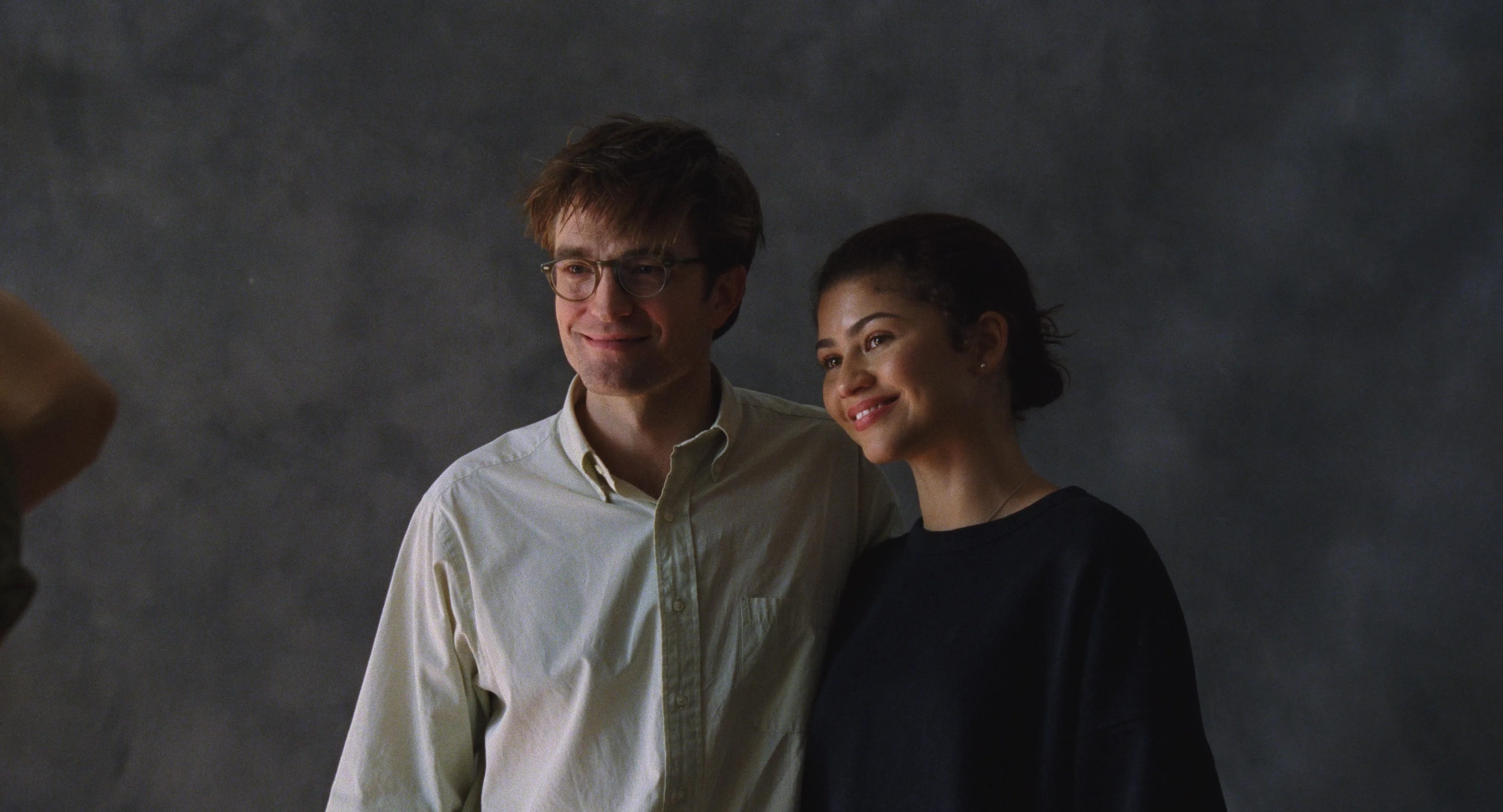
After Emma’s confession, these intercut sequences take on the shape of intrusive thoughts. Charlie can’t stop seeing Emma as her younger self (played by Jordyn Curet). Emma imagines Charlie and Mike plotting about how best to call the wedding off, the two men’s conversation growing more unhinged as Emma spirals out about what they must think of her. When Emma and Charlie discuss the final details of the wedding with their photographer, the camera pushes in slowly on the couple over the course of a few minutes, inching closer and closer as their respective senses of self-confidence and mutual trust begin to break down.
The film is hyperfocused on its characters’ mental distress. As a technical expression of that discomfort, it’s brilliant work; Borgli focuses on the ways both halves of a couple might feel, should one of their most shameful secrets come to light. It’s the kind of drama that can only be resolved by communication. Thankfully, Charlie and Emma do talk to each other—this isn’t a dramedy in which a single conversation would solve the problem. They discuss the issue; it’s all they can both think about. But despite all their talk, both characters question their ability to communicate with each other. The movie handles their respective subjectivity adequately; it stumbles whenever it brings up the possibility of complexity in the world. It is so interested in Emma and Charlie’s relationship alone that any reference to characters outside it feels like a perfunctory gesture at context. The problem the two are trying to solve is the same one we are all stuck with: the possibility that every person has the capacity for great evil, just as they are also capable of growth. We’re all more than our worst days and our intrusive thoughts. Like Charlie’s meet-cute, we all need a second chance. Despite The Drama’s occasional mistakes, I was happy to keep that conversation going. —Sarah Welch-Larson
★★★☆
The Drama is in theaters everywhere now.
Sarah wrote a book about the Alien movies! You can buy the second edition of Becoming Alien: The Beginning and End of Evil in Science Fiction’s Most Idiosyncratic Film Franchise from the publisher now.