

The Odyssey
Christopher Nolan makes the ancient feel immediate.

Ancient Greek storytelling is about inevitability: the march of the seasons, the cycle of time, and mortals’ inability to escape their fates, let alone contend with them. In these stories, the conclusion is foregone. There’s no arguing about it; once the oracle has spoken, you are doomed, and no amount of struggling can change it. No wonder Christopher Nolan gravitated toward Homer’s Odyssey. Nolan’s stories are consumed with notions of time and fate; they flow backward and forward, poking at the solid boundaries of cause and effect. His sensibility is a natural fit for a tale about a “complicated man,” to quote the opening lines of Emily Wilson’s Odyssey translation. Nolan’s Odysseus is a brilliant and broken man doomed to wander far from home long after the destruction of the city of Troy.
Nolan’s telling is appropriately massive—battle sequences with hundreds of soldiers on practical sets, all shot on the biggest possible cameras in the largest possible film format. It’s beautiful, breathtaking work. The storms at sea feel like the wrath of Poseidon, and the destruction of Troy is overwhelming. Nolan’s films have taken a turn for the apocalyptic in the last decade; in The Odyssey, it’s not the end of the world just yet, but you can see it looming on the horizon. Ancient Greek civilization is beginning to fall apart. Rumors circulate of a new civilization raiding from the sea. The old rules of hospitality—welcome the stranger and feed them, for they might be a god in disguise—are dead, traded in for suspicion and distrust.
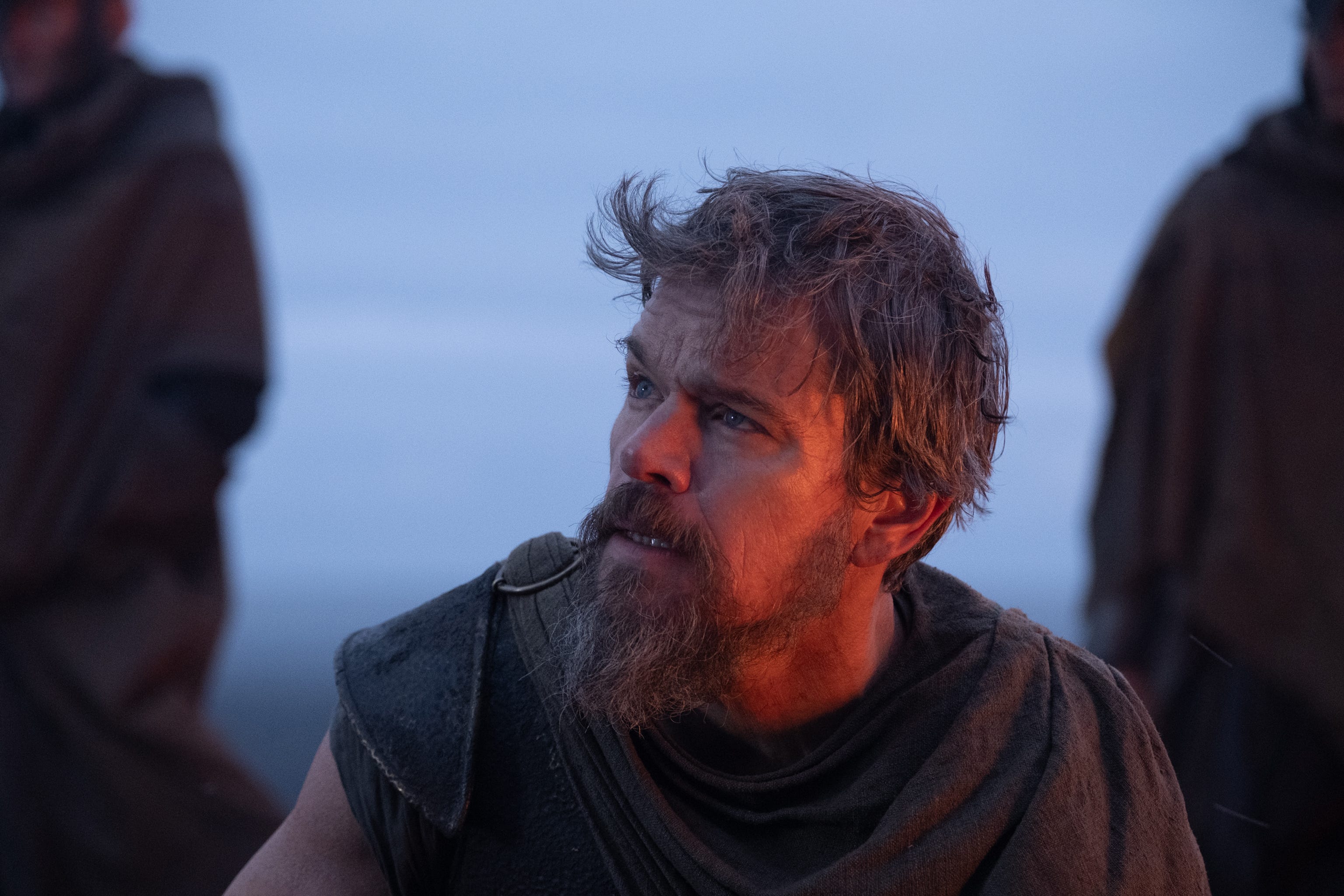
The scale might be large, but the stakes are personal, told plainly with contemporary language and startling tactility. Odysseus (Matt Damon) just wants to go home to his wife, Penelope (Anne Hathaway), and son, Telemachus (Tom Holland). Every obstacle on his journey could be fate or bad fortune, but Odysseus takes the loss of each man personally, and Nolan ensures that we feel that pain, captured in large-format film on the lines on Damon’s face. We see the death of one of his soldiers (played by Elliott Page) twice: once outside the Trojan horse, where Page’s character guards it, and again from Odysseus’s perspective inside the horse. The second time, we see that the spear that killed the soldier also narrowly missed the hidden Odysseus, and the look of pain on his face tells us that it might have been better if he’d been killed alongside his man, too.
Odysseus’s will to live, his desire to protect his men, and his need to go home all sit in tension with one another. He’s bound by a fate that he can’t control. Back home, Penelope is bound by tradition, courted by a crowd of unwanted suitors who want to take Odysseus’s throne as king of Ithaca. Hathaway is a particularly good match for Damon, even though their characters have been separated by long miles and longer years. She wears her care on her face the same way he does, and when she feels the first glimmer of hope that her husband might return, we see that hope flicker across her face, flame-like, alongside worry and fear and pride. She’s been holding out as long as she can, restricted by the need to show hospitality to men who are all too willing to take advantage of it for a chance at seizing power.
It’s a familiar story, full of themes to which Nolan is no stranger. The film is a little looser than his recent work, but it’s still calculated, constructed from interlocking memories and flashbacks, his exposition taking the form of story and song. Despite this familiarity, Nolan keeps finding ways to make the story strange and new, grounding it in dirt and tears and the salt of the sea. In a brief opening crawl, the film tells us it’s a time of apparent magic, but that magic is embodied, the kind that sees men turned into pigs by having their flesh pushed around like clay. Gods like Athena (Zendaya) appear to Odysseus in times of trouble, looking and speaking as humans do.
In this tale, humans find themselves on the brink of dark days growing darker, torn between a desire to live out their ideals and their need to sate their bloodlust in a cycle of revenge. Odysseus wanders a narrow path between the two, feeling personally responsible for the destruction of Troy, longing to return home to a peace that he might never be able to retrieve. He is haunted by the lives he took, directly and indirectly, through his own actions—a man anguished by war and everything he did to keep the wheels of conflict turning. We’ll keep telling iterations of the same story forever. Nolan’s version is a worthy retelling. —Sarah Welch-Larson
★★★★
The Odyssey is in theaters everywhere now.