

Weapons
Zach Cregger’s Barbarian follow-up is a fairy tale.

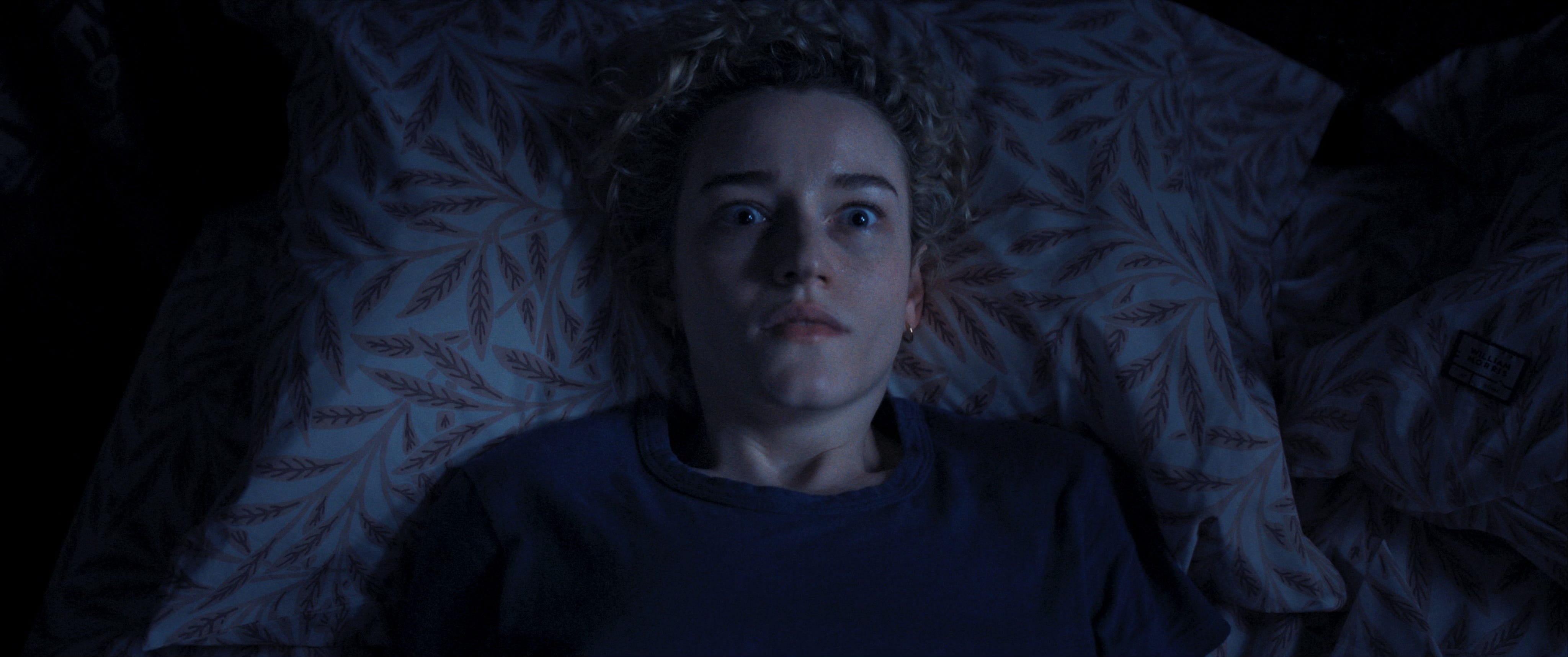
One night, at 2:17 AM, seventeen children in the same third-grade class woke up, walked out their front doors, and ran away into the dark, and, we’re told in Scarlett Sher’s voiceover, “They never came back.” Sher’s voiceover is delivered in the urgent tones of a rumor repeated in the schoolyard. Those kids totally disappeared under spooky circumstances. I knew someone who knew someone who disappeared. Maybe it could happen again. It’s the stuff of urban legends, told using the dreamlike imagery of a fairy tale.
Writer/director Zach Cregger understands the cadence of bad dreams and the imagery of fairy tales. His first movie, Barbarian, takes a classic lost-in-the-woods story and transplants it into a decaying neighborhood in Detroit. Instead of a forbidden castle, we have an Airbnb occupied by a sketchy double-booked renter; instead of a curse, we have a metaphor for white flight, gentrification, and the abuse that enables both. All of it is wrapped up in a rip-roaring, twisty package. I’ll always think of rental homes with cavernous unfinished basements as “Barbarian houses,” for better or worse, though the “better” part of that association outweighs the “worse,” largely because the movie was so much fun to watch in a theater full of screaming people.
Weapons, like its predecessor, is also twisty fun, the kind of movie that benefits from a keyed-up audience looking for a good scare and willing to trade additional metaphors for a shriek or a laugh. (As with Barbarian, Weapons is darkly funny.) Cregger pulls his horror from a handful of basic building blocks that have proven effective in myriad movies before this one. Dark doorways and giant scissors have always been scary. Weapons treats those objects as though they’re ordinary first, then deploys its scares with impeccable timing. Things become scary with a turn of the head, a small shift in lighting, a sudden stiffness in an actor’s arms as they run. Sometimes you can watch the turn as it happens, the scene adjusting its pace to the horrifying crawl of a waking nightmare.
The cast, setting, and scope of Weapons are all much bigger than its predecessor, and it’s satisfying to see a director who has already taken a big swing making his next movie even more ambitious. During the prologue, we meet most of the major players, though they keep their backs to the camera. As we get to know each of the characters in turn, the camera reveals their faces and manifests their emotional tics into imagery. Justine (Julia Garner), a teacher under intense pressure after the children in her classroom disappear, darts from house to car to liquor store, her head occupying the center of the frame and her surroundings left blurry by the camera’s shallow focus. She’s living in her own head, and we feel her insecurity and self-absorption. Another character named James (Austin Anthony) finds himself running in a panic-stricken moment, and the camera acquires a wild, low Dutch angle to match his fear. The police officer (Alden Ehrenreich) who is chasing him experiences the same sequence at a mental remove, so the camera is held steady at a middle shot just above his head.
All their stories interlock in chapters named for each character, revealing additional details with each overlapping scene. Weapons is less a puzzle box and more a series of sprawling layers; the timeline and the clues to the mystery are less important than the hole left at the center of a town by the disappearance of an entire classroom of kids. That might sound like a metaphor for a school shooting, and Cregger nods to that specific fear. But the real horror at the heart of this story is slippery, refusing to be boiled down to a simple simile. Cregger plays fair with the audience—it’s possible to suss out the shape of the story a half-step ahead of the characters, based on a few context clues, though the hints never feel patronizing. Neither do they fully add up, but that doesn’t matter against the emotional thrust of the story: a classroom of children has gone missing, and everyone involved has to grapple with that somehow.
I read Weapons as a campfire fairy tale. Not the ones with a moral at the end, but the more frightening Grimm stories: evil exists, and it’s both weird and ordinary, an unexplainable thing that still has power, something we can hoot at in the dark. There’s power in communal processing, and there’s power in collective laughter, and Weapons manages to balance the two in such a way that it delivers both horror and a joke, often simultaneously. We’re all just muddling through, looking for catharsis in a world gone mad. Weapons delivers—on both the madness and the catharsis.—Sarah Welch-Larson
★★★☆
Weapons is in theaters everywhere.